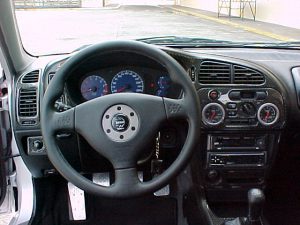
Group A cars
In order to compete in the FIA Group A a vehicle has to be produced to numbers above 2500 units to get the FIA homologation. No manufacturer can afford to produce the like of the monstrous, but exciting, Group B cars in this class (it would be financially impossible given the relatively important production numbers required). Nowadays rally cars resemble (at a distance) everyday cars much more than group B cars ever did, hence a more direct marketing impact and, thus, a more effective promotion of a car range for the manufacturers.
Note however that technology improvements (mainly in tires, brakes, transmission and engine management) make today’s group A and WRC cars faster than the Group B monsters were!
Most of today’s top Group A (A8) cars have in common:
- 4 wheel drive transmissions
- liter turbo charged engines (there’s an FIA 1.7 engine displacement multiplication factor for turbo charged cars) using a 34mm turbo restrictor
- Front mounted engines (longitudinal or transversal)
- inimum weight of 1230 Kg
- Active differentials
Modifications allowed according to FIA Group A regulations:
- Full suspension geometry and layout. The original mounting points must be preserved within a 20mm radius
- Engine internals including camshafts, crankshaft, valves. Other engine components can be machined. The engine bloc must be preserved
- Engine peripherals (Radiators, intercoolers, …)
- Engine management
- raking system
- Gearbox, gear ratios, number of gears and gear selection type
- Differentials
- Final drive ratio
- Electric equipment
Note that these rules are subject to revision and changes relatively frequently. For more information please refer to the FIA complete guide to the allowed Group A modifications here (Adobe Acrobat file).
Some of the most successful incarnations of current Group A cars are:
- The Ford Escort and Sierra RS Cosworth
- The Lancia Integrale
- The Subaru Impreza
- The Mitsubishi Lancer and Carisma Evolution IV
- The Mitsubishi Lancer and Carisma Evolution V
- The Mitsubishi Lancer and Carisma Evolution VI
- The Toyota Celica GT4
Today’s Group A cars are real racing cars with no suspension, engine or drivetrain bushing, fully adjustable suspension, straight cut non-synchronized gears, sequential shifting and the like.
OK, you’ll ask. If these 4WD turbocharged cars are so great how come they were matched, or even beaten in some cases, by Group F2 (2 liter non turbo, 2 wheel drive cars also known as kit cars belonging to the FIA A7 class). The answer to that question is weight. Group F2 cars weighted 300Kg less than their 4 wheel drive turbo charged counterparts and as you might already know, weight is the worst enemy of any race car. Additionally F2 cars could only match the 4WD cars on dry tarmac surfaces.
Group F2 cars were created to reduce the cost of building a rally car. Some of them such as the Peugeot 306 Maxi (picture here), Renault Maxi Megane (picture here), Renault Clio Maxi, the Citroën Xsara and others cost approximately the same or even more than the turbo charged 4×4 cars. The price argument was not valid. This category of rally car was created only because some manufacturers preferred to promote, through rallying, cars that were more appealing to the general public without spending on the development of four wheel drive transmissions.
The existence of F2 cars threatened the turbo charged 4 wheel drive cars. These cars were far less spectacular than the 4 wheel drive cars are. F2 cars were driven to extinction past 2001 due to FIA’s decision to add 80Kg to their minimum weight and apply an intake restrictor to their normally aspirated engines. They were replaced by the far lesser Super 1600 class, cars that also comply with GroupA regulations but use 1600cm3 engines with approximately 200bhp and a weight lower than 1000kg. These cars do not constitute a menace to WRC class cars on any surface.
The dominance of the GroupA cars brought, eventually, Japanese manufacturers in the race. While this is was excellent challenge to European manufacturers it had a downside: very big amounts of money and huge budgets were now part of the game. Toyota, Mazda, Subaru, Nissan and lately Mitsubishi have joined the World Rally Championship with cars that the Europeans had initially a lot of trouble matching. While Japanese cars were excellent (and most probably better than European ones) they were so only because the manufacturers behind them spend enormous budgets on their development. Additionally all Japanese WRC contenders were backed by European race teams (such as RalliArt and Prodrive). Apparently European manufacturers did not realize, at the time, the impact of a model being World Rally Champion on their sales numbers and spent quite some time trying to match the performance of the Japanese models with much lower budgets. The situation changed dramatically with the return of Peugeot to the WRC and their three consecutive wins of the manufacturers championship in 2000, 2001 and 2002. This fact comes to prove that adequate budgets are the major winning factor in today’s Word Rally Championship.
On the positive side, all Japanese racing cars are built in Europe by companies such as Prodrive (for Subaru), Ralliart (for Mitsubishi) and Toyota Team Europe. The know-how on building a pure breed is still in Europe.
On the negative side, the fact that today the amounts of money involved in rally racing are so important has changed the once “gentlemen” rallying world to an efficient and heartless machine reminding a lot the F1 championship. Rallying is, by nature, a sport very close to its public and therefore quite different to Formula 1. The FIA authorities must, at some point, realize that the attempt to transform rallying to something reminding the F1 Championship may eventually lead to the extinction of the sport as it opposes the very nature of rallying.