![]()
Aerodynamics:
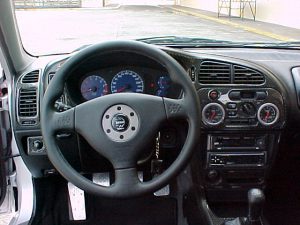
Mitsubishi has taken special care to lower the aerodynamic drag and better the engine bay air flow. There are now two openings on the bonnet. The front bumper is almost non-existent as it is filled with openings and holes everywhere. The lower blade spoiler that was present in the Evolution IV has been dropped. It is replaced by a newly designed lower front bumper. The rear wing spoiler has been completely redesigned and its blade is adjustable in four positions that go from simple to double the down force generated. Handling: The new evolution V of the Lancer is much more neutral than the Evolution IV was. The new transmission, the redesigned drivetrain and the better performing engine management all contribute to lower the understeering character of the previous version. The car now displays a neutral to slightly oversteering handling character. Overall the new evolution V is a finer version of an already extraordinary car. Its commercial success in Japan is simply huge. Mitsubishi produced, initially, slightly more than 6000 examples of the Evo V and all were instantly sold out. A total of 7500 orders came in and the company okayed the production of 1500 more cars. Unfortunately if you live outside Japan there are little to no chances you'll ever be able to put your hands on a Lancer evolution V. The Lancer evolution V, like its predecessor, is commercialized in two versions: the GSR and the RS. The latter is essentially a striped down version of the GSR. It has no airbags, no electric windows, a very spartan interior and a mechanical rear differential. The GSR version features an electronically controlled rear differential, which attempts to reproduce what is available in the competition versions, with little success. The RS version of the car weights 90Kg less than the GSR and is clearly destined to become a GroupN rally car. The conversion shouldn't be very expensive given the sophistication already built into the base version.
If the street version of the Lancer evolution V is awesome the competition version is simply staggering. Click here for its specs. The front and rear suspension and geometry have been completely revised. The most radical changes, compared to the Evolution IV, occur at the rear suspension. The front suspension transverse wishbones are the same as on the Evo IV but their mounting points on the chassis have been modified. The gear box is the same as the one used on the Evo IV but all its elements have been revised in order to reduce the overall inertia. As before all racing engines are prepared by MMC in Japan. The Evo V racing engines, unlike their commercial counterparts, use a higher compression ratio than the one used on the Evo IV.
*: pictures are courtesy of the Mitsubishi Motors Corporation in Japan |
![]()
©Copyright 1996-2008 Tryphon Georgallides, all rights reserved;