--------------------

The current competition version of the Impreza is a WRC class car. It has been engineered by Prodrive's chief engineer and technical director David Lapworth. Lapworth has worked with Peugeot in the rallying world where he collaborated in the development of the famous Talbot Sunbeam Lotus Group B car. This car was world champion in 1981 driven by the legendary Henri Toivonen.

Lapworth met with Richards, who was already managing Prodrive at the time, in 1981 and has worked with him ever since. Prodrive was preparing Porsche 911s for Toivonen and other drivers, they have been involved in rallying for more than 17 years now.

wrc_cutaway.gif (37582 bytes)

The WRC version of the Impreza

The competition Impreza is a car clearly built to win. The car is relatively compact and its mass distribution is almost optimal (56% at the front wheels and 44% at the rear). Its overall weight (unlike most modern cars) is relatively low, the car weights only 1235Kg in its street version. Prodrive had no trouble meeting the lowest weight limit for both Group A cars and WRC cars (1230Kg).

Subaru and Prodrive have been very active in developing and testing active (hydro-electronic) differentials. These were first introduced on the Toyota Celica (in 1986 I think) but were not used on racing cars at that time since Toyota Team Europe were unable to build them reliably enough (they went back to viscous couplers at the time). For the record I'll mention that Toyota Team Europe were also the first to introduce the ALS (a.k.a. bang-bang) engine management system in their cars in 1993. Subaru are the current masters in electronically controlled differentials. The current WRC version of the Impreza carries 3 computer controlled, high pressure hydraulic pumps that manage the front, rear and center differentials.

This system works as follows:
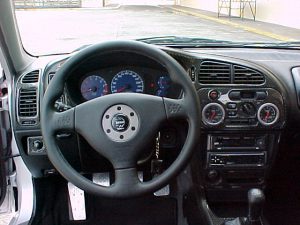
Each differential holds a kind of clutch which is controlled by the hydraulic pressure applied by a pump (these are high pressure pumps that can deliver upwards of 50 bar pressures). If the sensors, connected to the in-coming and out-going axles, detect slip the hydraulic pump applies more pressure to the clutch inside the differential in order to lock it. Depending on the hydraulic pressure applied the lock force varies constantly as related to the information sent by the sensors to the computer that controls each differential. Using the same system the driver can distribute torque between each axle from inside the cabin while the car is running. By doing this, the driver overrides the computer controlled circuitry and decides whether the front or rear axle should get more torque from the engine. The driver can, thus, apply more torque on the rear axle when racing on tarmac, equal torque between axles on gravel and even convert the car to a simple (well almost) front wheel drive. Additionally there's a switch on the car's dash that allows the driver to lock the center differential in order to allow spin-free starts on wet tarmac or snow stages.

Note that the system's principle is not new. The Ford RS200 and Lancia S4 Group B cars had a similar mechanism (although not as sophisticated and mechanically controlled) that could change torque distribution between axles from inside the cabin through a lever. The RS200 had this device installed even in its street version although it was disconnected on most road cars.


Next

--------------------

 ©Copyright 1996-2008 Tryphon Georgallides, all rights reserved;

homeindexBack to the previous page