![]()
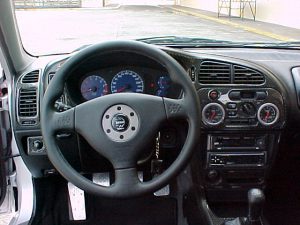
The driving position of Peugeot's new contender must be one of the highest sitting ones of all WRC cars. In order to fit the transmission tunnel, which is of course not part of the base model, Peugeot engineers had to elevate the driver's seat quite a bit. The car's engine has been placed as close as possible to the center of the car (WRC car regulations allow a manufacturer to move the engine by 20mm as compared to the base car) and makes the cabin even more cramped. From a driver's point of view, however, this is more of an advantage than anything else since the relatively high sited position allows for better visibility. The 206 WRC being a World Rally Car you cannot, of course, buy it at your local Peugeot dealer. The company will only manufacture competition cars since there's no longer a need to produce street versions to get the FIA homologation. That's one of the true downsides of the new regulations. Back in the GroupA class days a manufacturer had to produce 2500 samples of a car resembling the competition car to get it to race. Even in the old GroupB car days 200 sample cars had to be produced. The FIA wanted to draw as many manufacturers as possible in the WRC and thus avoided to scare them off with the substantial financial investment that's involved in producing street versions of their rally cars. While the new regulations did manage to draw new manufacturers in the WRC (Hyundai, Seat, Peugeot, Skoda, ...) they shuttered the dreams of people like you and me to get our hands on cars that had something (well not that much but even so) in common with those involved in racing. One might think that Peugeot have nothing to prove anymore in World Rallying. I would say their situation is a bit ambiguous. A pointer that allows to better understand their status is that they very conservatively announced that the 206 WRC would compete in 1999 to finish its setting up and would head for the WRC manufacturer's title only in 2000. The mission was a complete success with the company not only fulfilling its promise to win the manufacturer's title in 2000, they did so and brilliantly, but also pushing Marcus Grönholm to the highest step in the WRC hierarchy and allowing him to win the 2000 WRC championship. Consider that the past must have also been a big burden for the Peugeot Talbot Sport (PTS) team. They had to prove themselves in an environment which is much more competitive than it used to be back in the old GroupB days. The PTS drivers for the 1999 season had been announced quite early. The 206 WRC was driven by François Delecour, Gilles Panizzi and Marcus Grönholm. François, the most experienced among them, masters most surfaces and already has extensive experience of 4WD turbocharged cars (drove for Ford the Sierra and Escort Cosworth) as does Marcus (drove the Toyota Celica GTFour and Corolla WRC). Marcus is more keen of slippery surfaces though (gravel and snow) and is not known as a tarmac specialist. Gilles is a very gifted tarmac driver with little experience of 4WD turbocharged cars. He's very willing to learn the tricks of slippery road racing and has even taken part in the 1998 Finnish rally driving a "small" GroupN Peugeot 106 just to get the feeling of gravel racing. This is very admirable as not a lot of drivers of his talent would be willing to undergo the same experience. Note that both François and Gilles were part of the PTS team for 3 years prior to joining the 206 WRC project. François was dismissed from the team in late 2000, for obscure reasons, and joined his old mates at Ford. Peugeot hired Didier Auriol, Seat refugee and former World Champion, to replace him only to fire him too a year later. All in all Peugeot used a very wise and conservative approach to carry out their WRC comeback. They spent 4 years restructuring the team, getting to know their drivers, engineers and managers when they were working on the 306 Maxi kit car. The company now has a very capable team and their car has already proved its winning potential. The 206 WRC car scored its first win on February the 5th 2000 at the Casinos da Póvoa rally in Portugal driven by Adruzilo Lopes. The car scored its first WRC win in 2000 Swedish rally driven by Marcus Grönholm. It won the WRC manufacturer's title that same season.
Feedback ? Comments ? İCopyright 1996-2002 Tryphon Georgallides, all rights reserved; |
![]()